Orthopedic Referrals · Atlanta, GA

Specialist care for lateral epicondylitis in Atlanta

Tennis elbow is a tendon condition, not a simple strain — and it responds best to physicians who treat it regularly. Connect with board-certified Atlanta specialists across sports medicine, orthopedics, and interventional pain management.

Real Results

Beyond the Clinical Terminology

Lateral epicondylitis is a clinical term; chronic pain is a daily reality. A TenJet patient describes both sides of that.

TenJet Patient Testimonial

Video courtesy of HydroCision, Inc., the maker of TenJet®. Individual results vary; this patient's experience is not a guarantee of outcome. Talk with a specialist about whether the procedure is appropriate for you.

6
Board-certified Atlanta specialists listed
95%
Of tennis elbow cases resolve without surgery
15–30
Minutes for an in-office TenJet procedure

Understanding the Condition

What is lateral epicondylitis?

Despite the name, tennis elbow affects far more office workers, tradespeople, and weekend athletes than tennis players. Understanding the injury helps you understand why specialist care matters.

Causes & Risk Factors
Repetitive gripping, lifting, or forearm rotation gradually breaks down the tendon fibers at the lateral epicondyle. Onset is typically gradual, peaking between ages 30 and 50.
Symptoms to Watch
Burning pain on the outer elbow, weakened grip, discomfort lifting even light objects, and pain that worsens with wrist extension. Symptoms may radiate down the forearm.
Treatment Pathway
Conservative care resolves most cases: rest, physical therapy, and bracing. Persistent cases respond well to PRP therapy or the TenJet procedure. Surgery is rarely needed.

Advanced Treatment

The TenJet procedure for chronic tennis elbow

For lateral epicondylitis that hasn't responded to conservative care, TenJet offers a minimally invasive option that physically removes degenerated tendon tissue rather than masking the pain with injections.

TenJet® Percutaneous Tenotomy

How it works

Under continuous ultrasound guidance, the treating physician makes a small incision and advances the TenJet device's small-gauge probe directly to the degenerative portion of the common extensor tendon. A precise, high-pressure saline jet simultaneously breaks down and removes the damaged collagen, while an integrated aspiration channel clears the debris and leaves healthy fibers intact. The entire procedure typically takes 15–30 minutes in an office or clinic setting under local anesthesia.

Why it works for tennis elbow specifically

Chronic lateral epicondylitis is a tendinopathy — a degenerative condition — not a simple inflammation. Cortisone injections reduce inflammation temporarily but don't address the underlying degenerated collagen, which is why pain returns. TenJet mechanically removes that degenerative tissue at the common extensor origin, targeting the actual source of chronicity, with results confirmed under real-time imaging.

How it compares
Cortisone injection
Reduces inflammation temporarily. Does not remove degenerative tissue. Pain typically returns within weeks to months.
TenJet debridement
Physically removes degenerative collagen under ultrasound guidance. Small incision, local anesthesia, office procedure. Addresses the source.
PRP therapy
Stimulates a healing response but does not remove existing diseased tissue. Complementary, not equivalent.
Surgical release
Open or arthroscopic tendon release. Effective but requires a surgical center, general anesthesia, and longer recovery.
Small incision, performed in-office under local anesthesia
No general anesthesia or surgical center required
Real-time ultrasound guidance throughout
Most patients return to normal activity within days to weeks
Treats the degenerative tissue — not just the pain

TenJet® in Action

Official demonstration video from HydroCision, the maker of TenJet, plus a look at how tendinitis differs from the deeper tissue degeneration TenJet is designed to treat.

TenJet Lateral Epicondylitis Minimally Invasive Tenotomy

Healthy tendon fiber structure diagram
Healthy Tendon
Tendinitis inflamed tendon diagram
Tendinitis
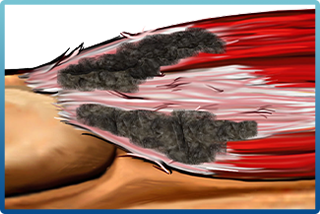
Tendinosis degenerated tendon fiber diagram
Tendinosis (Chronic Degeneration)

Diagrams and video courtesy of HydroCision, Inc.

Common Questions

Frequently Asked Questions

Why does my elbow still hurt after months of rest?

Because rest addresses inflammation, and long-standing lateral epicondylitis is usually degeneration instead. Damaged collagen does not remodel on its own simply by avoiding the aggravating activity.

What does the ultrasound guidance accomplish?

It lets the physician see the diseased region and the needle simultaneously, in real time, so treatment is directed precisely at the damaged tissue rather than estimated from surface landmarks.

How much pain should I expect during treatment?

Your physician will select numbing appropriate to your procedure. Most discomfort reported by patients occurs while the anesthetic is being administered and again as it wears off.

Is there published evidence behind this?

Yes. Peer-reviewed case reports and outcome data exist, including Dakkak M, et al., Cureus 2023;15(8):e43972. Discuss the evidence base directly with the physician evaluating you.

This information is general and is not medical advice. Whether any procedure is appropriate for you can only be determined by a physician who has examined you and reviewed your imaging.

Speak Directly With Each Physician's Office
Call the office below that matches the specialist you'd like to see.
CC
Sports Medicine & PM&R
Northside Hospital Orthopedic Institute
(770) 795-5620
MS
Non-Operative Orthopedics
Northside Hospital Orthopedic Institute
(770) 758-5059
KK
Dr. Kamal Kabakibou, MD
Interventional Pain Medicine
Center for Pain Management, Atlanta
(404) 882-9778
EO
Interventional Pain Medicine
OlympusMD Pain & Wellness
(770) 629-9023
OH
Interventional Pain Medicine
OlympusMD Pain & Wellness
(770) 629-9023
UN
PM&R & Spine
Resurgens Orthopaedics, Covington & Decatur
(404) 856-3706